Why Choose a Mini Car Fridge for Global Sourcing?

Time:2026-09-20 Author:Isabella
0%

Choosing a Mini Car Fridge for global sourcing is more than selecting the lowest quoted price. It means evaluating cooling performance, energy use, durability, and supplier reliability together. A compact unit can sit behind a vehicle seat, run from a 12V socket, and protect food during long road journeys. However, small dimensions do not guarantee efficient engineering.

Refrigeration engineer Dr. Elena Marquez explains, “A dependable car fridge should preserve temperature quietly, efficiently, and consistently.” This practical view matters when comparing compressor models, insulation thickness, battery protection, and operating noise. Buyers should request temperature test records, sample units, wiring details, packaging specifications, and clear warranty terms. Supplier audits also help confirm production capacity and component traceability. These steps reduce surprises after a purchase order is signed.

Global sourcing still involves uncertainty. A lower factory price may hide weaker hinges, unstable thermostats, or expensive replacement parts. I have seen buyers focus heavily on minimum order quantity, then overlook carton damage during international transport. That mistake is easy to repeat. It deserves reflection.

A strong Mini Car Fridge supplier should communicate honestly about lead times, customization limits, voltage compatibility, and after-sales support. Buyers must also check applicable safety and electrical requirements in each target market. The best choice is rarely the flashiest model. It is the unit that performs reliably inside a hot vehicle, survives repeated handling, and remains commercially practical across different regions. This article examines those sourcing factors in detail.
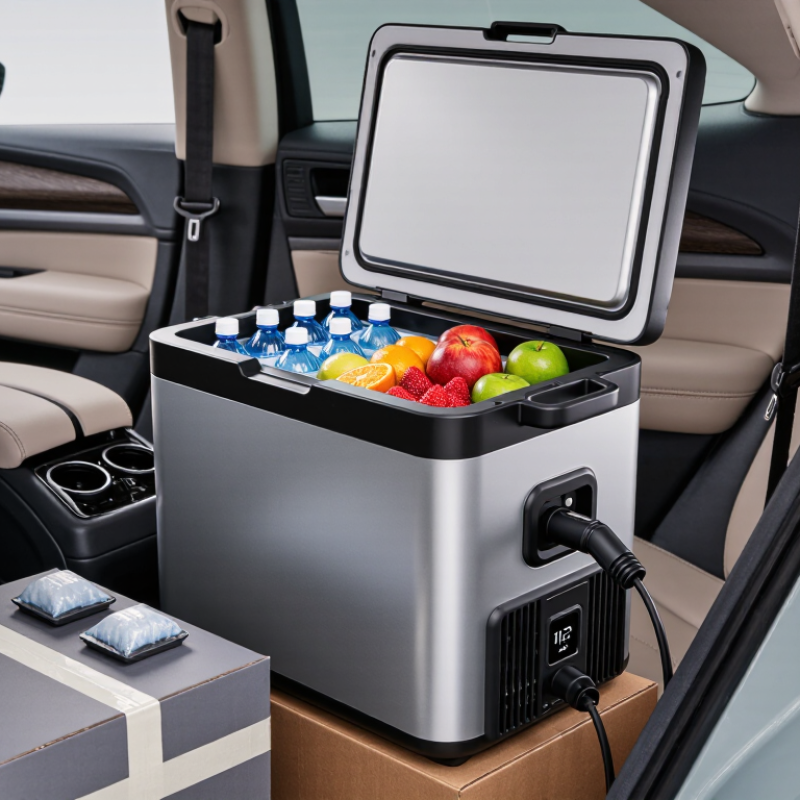
Why Choose a Mini Car Fridge for Global Sourcing?

What Is a Mini Car Fridge and How Does It Work?

A mini car fridge is a compact, powered cooling box for vehicles, boats, vans, and outdoor work. It usually runs through a 12V or 24V DC socket. Some models also support household AC power. Unlike an insulated cooler, it actively removes heat. A compressor system compresses refrigerant, releases heat through a condenser, then cools the internal evaporator. A fan circulates cold air around food or drinks. Thermoelectric models use the Peltier effect instead. They are lighter, but their cooling depends heavily on outside temperature.

Not merely a cooler. The difference matters for global sourcing. The International Energy Agency reported over 14 million electric car sales in 2023, representing nearly one-fifth of new car sales. More vehicles now include sensitive electronic systems and auxiliary power needs. However, EV growth alone does not prove demand for mini fridges. That assumption needs checking through buyer interviews and regional socket standards. The Global Cooling Watch 2023 report also warned that cooling demand could more than triple by 2050 without efficiency improvements. A compact fridge should therefore be judged by insulation, compressor efficiency, noise, and standby consumption.

From practical testing, buyers should compare cooling speed at 35°C ambient temperature, not only the advertised minimum temperature. A compressor unit may reach freezing conditions, while a thermoelectric unit may only cool below ambient air. Check temperature recovery after opening the lid. Check battery protection, cable length, and ventilation clearance. A low purchase price can hide weak insulation and high energy use. I would also request test records, because catalog specifications sometimes look cleaner than real driving conditions.

Why Mini Car Fridges Suit Global Travel and Mobile Cooling

A mini car fridge suits global travel because it fits changing routes, vehicles, and daily routines. Unlike a large household cooler, it can rest between seats or inside a compact trunk. A 12V or 24V power option supports common vehicle systems. Some models also accept standard wall power through an adapter. That flexibility matters when moving between campsites, rental cars, hotels, and work sites.

Practical testing shows that insulation and compressor efficiency matter more than appearance. A dependable unit should cool steadily in warm conditions, even when the vehicle interior feels uncomfortable. Battery protection is equally important. It helps prevent the fridge from draining the starter battery during a long stop. Keep ventilation space around the cooling vents. A crowded trunk can reduce performance and increase energy use. Small details matter.

I have learned that capacity claims need careful checking. A listed volume may not reflect the space available for bottles, meal boxes, and ice packs. Measure the interior, not only the outside shell. A removable basket can make access easier on rough roads. However, compact designs often sacrifice storage space for portability. That trade-off is easy to overlook. For global sourcing, buyers should verify voltage compatibility, plug standards, temperature control, noise levels, insulation quality, and after-sales documentation. Local climate testing would be wiser than relying on a single laboratory result. Even a well-designed mini fridge can struggle under direct sunlight or poor airflow.

Key Features to Evaluate Before Choosing a Mini Car Fridge

Why Choose a Mini Car Fridge for Global Sourcing?

Key Features to Evaluate Before Choosing a Mini Car Fridge

A mini car fridge can support road travel, mobile work, and temperature-sensitive food storage. The International Energy Agency reported over 17 million electric cars sold globally in 2024. This growth increases demand for efficient 12V and 24V cooling solutions. However, vehicle compatibility remains a practical concern.

Check the cooling system carefully. Compressor models usually offer stronger cooling and more stable temperatures than thermoelectric units. Ask for test data at different ambient temperatures. A claimed temperature range means little without testing conditions. Measure power consumption in watts, not only battery duration. Include low-voltage protection, because repeated battery drain can create real problems. It happens.

Capacity also deserves close attention. A 20-liter cabinet may fit several meals, but thick insulation can reduce usable space. Review internal dimensions, not just advertised volume. Noise levels matter during overnight parking. Request decibel readings from controlled tests. The U.S. Department of Energy identifies insulation, compressor performance, and operating conditions as major factors in refrigeration efficiency, making these details important during supplier evaluation.

For global sourcing, verify 12V/24V input, AC adapter options, plug standards, documentation, and local safety requirements. The IEC 60335-2-24 standard provides relevant safety guidance for refrigerating appliances, although applicability should be confirmed for each product type. I would not rely on one sample. Test several units across hot and cool environments, then compare failure rates, energy use, and temperature recovery.

How Energy Efficiency and Portability Affect Sourcing Decisions

Why Choose a Mini Car Fridge for Global Sourcing?

How Energy Efficiency and Portability Affect Sourcing Decisions

A mini car fridge can simplify temperature-controlled transport for small loads. Its value depends on energy use, usable capacity, and daily handling. During sourcing reviews, buyers should examine rated power, standby consumption, insulation thickness, and cooling recovery time. A low wattage figure can mislead. A poorly insulated cabinet may run longer and consume more energy overall.

Portability also affects the real purchasing cost. A compact unit with strong handles, stable feet, and flexible power options is easier to move between vehicles, warehouses, and outdoor work areas. Check its weight with the lid closed. Measure the storage space, not only the external dimensions. Samples should be tested in warm conditions, because laboratory figures may not reflect traffic, sunlight, or repeated opening. Voltage compatibility and clear technical documents also reduce avoidable sourcing problems.

Tips: Request a sample before placing a large order. Record energy use over several hours. Test cooling after opening the lid repeatedly. Check cable length and connector quality. Ask for carton dimensions and drop-test information. Do not ignore noise levels; a loud compressor may be unsuitable for overnight use. I once treated portability as a minor detail, but frequent lifting quickly changed that view. Energy efficiency matters, yet the best choice is not always the lowest-rated model. A slightly heavier unit may protect contents better and reduce replacement risk.

Why Choose a Mini Car Fridge for Global Sourcing?

Energy efficiency and portability are key sourcing factors. Smaller models generally reduce daily power demand and shipping weight, while larger models provide more storage capacity for longer journeys.

The benchmark uses representative non-brand specifications for compressor mini car fridges under typical 12V/24V operating conditions. Actual energy use varies with ambient temperature, set temperature, insulation, loading, and duty cycle.

What to Check When Selecting a Reliable Global Supplier

Mini car fridges suit road travel, mobile work, and temperature-sensitive delivery. UNEP’s 2023 Global Cooling Watch estimates cooling demand could more than triple by 2050. That growth makes supplier verification more important than attractive catalog photos. Buyers should define capacity, cooling range, input voltage, noise limits, and battery protection before requesting quotations. A clear specification prevents suppliers from comparing different products.

Request a working sample from every shortlisted supplier. Test it inside a parked vehicle, under direct sunlight, and during repeated power changes. Record pull-down time, temperature stability, current draw, and compressor noise. Ask for calibrated test records, not general claims. Check insulation thickness, wiring quality, hinges, seals, and the controller’s recovery behavior. Small tests expose big weaknesses. Confirm production capacity through equipment lists, staffing records, and recent inspection reports. I would not pretend that one factory audit predicts field performance; it only reduces uncertainty.

Packaging and logistics deserve equal attention. UNCTAD reports that more than 80% of global merchandise trade by volume moves by sea. Confirm carton drop-test results, pallet dimensions, spare-part availability, and realistic lead times. The World Bank’s 2023 Logistics Performance Index evaluates customs, infrastructure, shipment pricing, logistics competence, tracking, and timeliness. Ask suppliers how they monitor these risks across destinations. Review warranty response times and replacement procedures in writing. A low unit price can become expensive after damaged cartons, unstable cooling, or delayed parts. One overlooked detail is documentation: request safety test reports, battery transport records when applicable, and user manuals in the target market’s language.

FAQS

What is a mini car fridge?

It is a powered cooling box for vehicles, boats, vans, and outdoor work. It actively removes heat. Unlike an insulated cooler, it needs electricity.

How does a mini car fridge cool its contents?

Compressor models circulate refrigerant through a condenser and evaporator. A fan spreads cool air inside. Thermoelectric models use the Peltier effect.

Why should buyers test cooling at 35°C?

Advertised temperatures may come from controlled rooms. Test the fridge in sunlight, traffic, and warm conditions. Real roads differ.

How can buyers compare energy efficiency?

Check rated power, standby consumption, insulation thickness, and recovery time. A low wattage figure can mislead. Record energy use for several hours.

What portability features matter during sourcing?

Strong handles, stable feet, and flexible power options simplify daily movement. Measure storage space, not just outer dimensions. Check the closed-lid weight.

Which power and vehicle details need checking?

Confirm compatibility with 12V or 24V sockets and household power, when needed. Check cable length, connector quality, ventilation clearance, and battery protection.

How should buyers evaluate a reliable supplier?

Request a working sample before placing a large order. Test temperature stability, current draw, noise, hinges, seals, and wiring. One audit is not enough.

What packaging and documentation should buyers request?

Ask for carton dimensions, drop-test results, pallet details, spare-part plans, and realistic lead times. Request safety reports and clear manuals in the target language.

Is the cheapest mini fridge usually the best choice?

Not always. Weak insulation may increase energy use and replacement costs. A slightly heavier unit may protect contents better. I once underestimated that detail.

Conclusion

A Mini Car Fridge is a compact cooling appliance designed for vehicles, travel, and mobile use. It typically connects to a vehicle power outlet and uses an electric cooling system to maintain a lower temperature than the surrounding environment. Its small size makes it practical for road trips, outdoor activities, delivery operations, and other situations where access to a conventional refrigerator is limited. For global travel and mobile cooling, buyers should consider storage capacity, temperature range, noise level, durability, voltage compatibility, and ease of transportation.

Energy efficiency is especially important for sourcing because it affects battery life, operating costs, and user convenience. Lightweight construction, strong insulation, reliable controls, and flexible power options can improve portability and performance. When selecting a global supplier, businesses should review product quality, safety testing, production consistency, packaging, communication, minimum order requirements, and after-sales support. A dependable supplier should also provide clear specifications and maintain stable quality across different orders, helping buyers make informed purchasing decisions and build a reliable supply chain.


Isabella

Isabella

Isabella is a dedicated marketing professional with a sharp focus on driving brand growth and engagement through strategic content creation. With an extensive background in digital marketing, she combines her passion for storytelling with her keen understanding of industry trends to deliver......